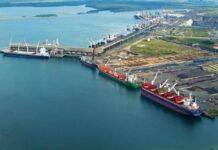


The Development Bank of Southern Africa (DBSA) is accelerating efforts to secure a private investor for the Richards Bay Dry Bulk Terminal (RBDBT), moving to revitalize a critical export hub and claw back regional market share lost to neighboring Mozambique.
Acting as the coordinator for public sector infrastructure projects, the DBSA has issued a request for proposal (RFP) to procure transaction advisory services. The appointed advisors will conduct legal and regulatory feasibility assessments, update existing data, and prepare the necessary procurement documents to bring a private partner on board.
The transaction marks a major structural shift for state-owned logistics giant Transnet, which will retain a 51% majority stake while handing a 49% equity slice and operational control to the chosen private investor.
“The transaction will be structured as a terminal-focused private sector participation, centred on the ring-fencing of terminal operations into a separate, commercially viable entity,” the DBSA stated in its request for proposal. “This will enable private sector equity participation and the introduction of operational expertise, technology, and capital investment to enhance capacity, efficiency, and service levels.”
The stakes are high for South Africa’s logistics network. The Richards Bay facility is one of Africa’s most vital multi-commodity dry bulk gateways, handling key industrial exports including chrome, magnetite, coal, woodchips, chloride, and alumina. However, aging infrastructure, deep-seated rail bottlenecks along the Richards Bay corridor, and structural rigidities have severely choked its output.
Transnet expects the introduction of private management to increase the terminal’s annual export capacity by 45%, raising throughput from 18.5 million tonnes to 26.9 million tonnes. The expansion will primarily target chrome and magnetite, which together comprise nearly half of the terminal’s existing volume and enjoy a robust long-term outlook tied to global green steel manufacturing.
Finding an operational solution is urgent. The Port of Maputo in neighboring Mozambique has increasingly squeezed Richards Bay, successfully capturing significant chrome and magnetite volumes—particularly from South African miners forced to haul cargo by road due to domestic rail failures. To qualify for the bidding process, prospective private partners must prove they possess at least R5.2 billion ($285 million) in available capital.
While South Africa holds the world’s largest chrome reserves, the domestic processing industry faces a steep uphill battle against global competitors. Local production has been crippled by surging energy costs, with domestic electricity tariffs skyrocketing by 947% since 2005. This margin squeeze has handed the competitive advantage to China, where power is roughly 50% cheaper, making it the world’s top chrome beneficiator despite lacking domestic reserves.
To sweeten the deal for long-term infrastructure investors, the state is moving to stabilize input costs for the energy-intensive sector. State power utility Eskom recently approved a temporary reprieve, granting local chrome miners a 54% reduction in electricity costs for a one-year period.
The DBSA emphasizes that a seamless logistical interface will be central to the terminal’s eventual turnaround.
“A key requirement of the transaction is the establishment of a clear legal and commercial framework governing the interface between the terminal operator, Transnet Freight Rail as the rail operator, and the broader port system,” the DBSA noted. This framework will include “defined access arrangements, performance obligations and co-ordination mechanisms to ensure reliable integration between rail delivery, terminal handling, and vessel loading.”